A morte do encaminhamento de portas: Como o WebRTC está salvando o Retro Netplay
Table of Contents
For the longest time, the “golden era” of retro gaming was trapped behind a wall of blue-text menus, confusing IP addresses, and the dreaded Port Forwarding. If you grew up in the 2000s trying to play a classic arcade fighter or an 8-bit platformer with a friend across the country, you likely spent more time in your router’s settings than in the actual game. You had to navigate 192.168.1.1, find the NAT settings, and pray that opening port 27015 wouldn’t leave your family computer vulnerable to every script kiddie on the block.
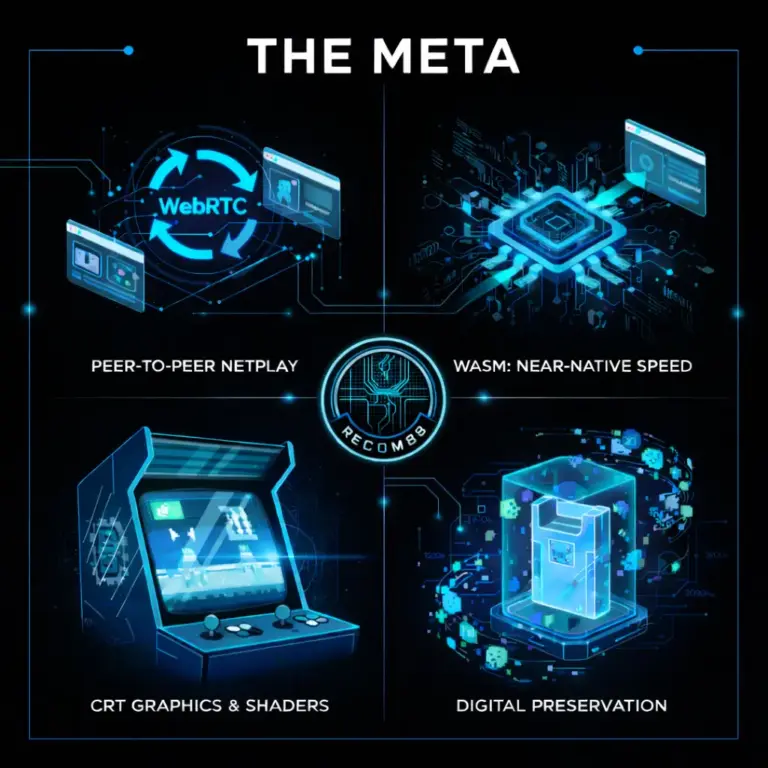
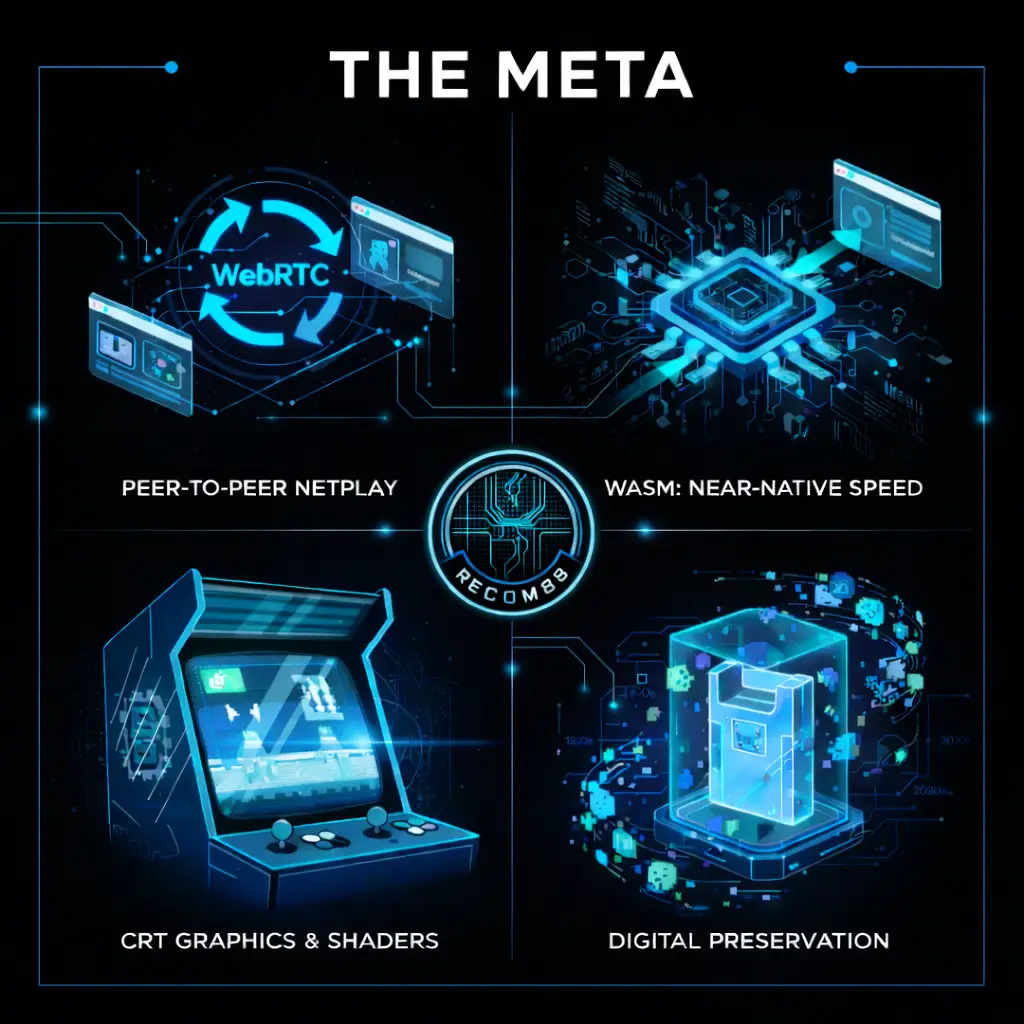
But at Rec0m88, we’ve moved past that. By leveraging WebRTC (Comunicação em tempo real na Web), we’ve effectively killed the need for manual network configuration. Here is a technical deep dive into why WebRTC is the revolutionary backbone of modern netplay and how it solves the “Connectivity Crisis” that plagued retro emulation for decades.
The Problem: The Great NAT Barrier
To understand why WebRTC is a game-changer, you have to understand why old-school netplay was so hard. Most home internet users don’t have a direct, public IP address for their computer. Instead, they live behind a NAT (Network Address Translation) gateway—your router.
When you tried to host a game in an old emulator, your friend’s computer would send a packet to your router, and your router would say, “I don’t know which device inside this house this packet is for,” and promptly drop it. This is why you had to “forward” the port. You were manually telling the router: “Anything coming in on Port X goes to my gaming PC.”
It was a friction-filled process that prevented 90% of casual players from ever experiencing the joy of 2-player retro gaming online.
The Solution: WebRTC and the “ICE” Framework
WebRTC doesn’t ask the user to fix the network; it fixes the network for the user. It uses a framework called ICE (Interactive Connectivity Establishment) to find the path of least resistance between two players. This process happens in milliseconds behind the scenes:
- STUN (Session Traversal Utilities for NAT): Your browser pings a STUN server just to ask: “What is my public-facing IP and port?” Once it knows its “public face,” it shares that with the other player through our signaling server.
- UDP Hole Punching: Because both players are sending “pings” to each other simultaneously, many modern routers see this as a “solicited” conversation and automatically open a temporary hole in the firewall. No manual port forwarding required.
- TURN (Traversal Using Relays around NAT): In roughly 10-15% of cases—usually on strict corporate or university networks—even hole punching fails. In these scenarios, WebRTC falls back to a TURN server, which acts as a high-speed relay, ensuring the game session still works where old emulators would simply fail to connect.
Why Not Just Use WebSockets?
Many web developers try to build games using WebSockets, but for high-speed retro games (like Street Fighter ou Contra), WebSockets are a disaster. WebSockets run on TCP (Transmission Control Protocol).
TCP is “reliable,” meaning if a single packet of data is lost, the entire stream stops and waits for that packet to be resent. In a game, this causes “hiccups” or “stuttering.” If your character jumps, but the packet is lost, the game freezes for 200ms while it waits for the jump command to arrive.
WebRTC uses UDP (User Datagram Protocol). In a UDP-based netplay environment, if a packet is lost, we just move on to the next one. This allows for a much smoother, “flow-state” experience where the latency feels consistent rather than jerky.
Security Without the Stress
One of the most overlooked benefits of the WebRTC approach on Rec0m88 is privacy. In the old days of sharing IP addresses over Discord or IRC, you were giving out your literal digital home address to strangers.
WebRTC in a browser environment is heavily sandboxed. It provides DTLS (Datagram Transport Layer Security) e SRTP (Secure Real-time Transport Protocol) encryption by default. Your data is encrypted end-to-end, and because it runs in the browser, the emulator never has “Admin” access to your local machine. You get the performance of a native C++ application with the security of a modern web browser.
The Future of Netplay is Zero-Config
At Rec0m88, we believe that the tech should disappear so the game can take center stage. By utilizing WebRTC data channels, we’ve reduced the barrier to entry for retro netplay from “IT Technician level” to “One-Click level.”
Whether you are hosting a lobby for a 4-player beat-’em-up or a 1v1 fighter, the complex dance of NAT traversal, STUN discovery, and UDP signaling happens in the blink of an eye. The era of the “unreachable host” is over.
Ready to test the latency for yourself? Jump into our Arcade Games and start a Netplay session to see WebRTC in action.