Daily Retro Game Challenges: How the Rec0m88 90-Second Arena Works
Daily Retro Game Challenges: How the Rec0m88 90-Second Arena Works
There’s something about a high score table that modern games lost. Back in the arcade days, your initials on the board meant something. It was public, it was simple, and everyone was playing the same game under the same rules.
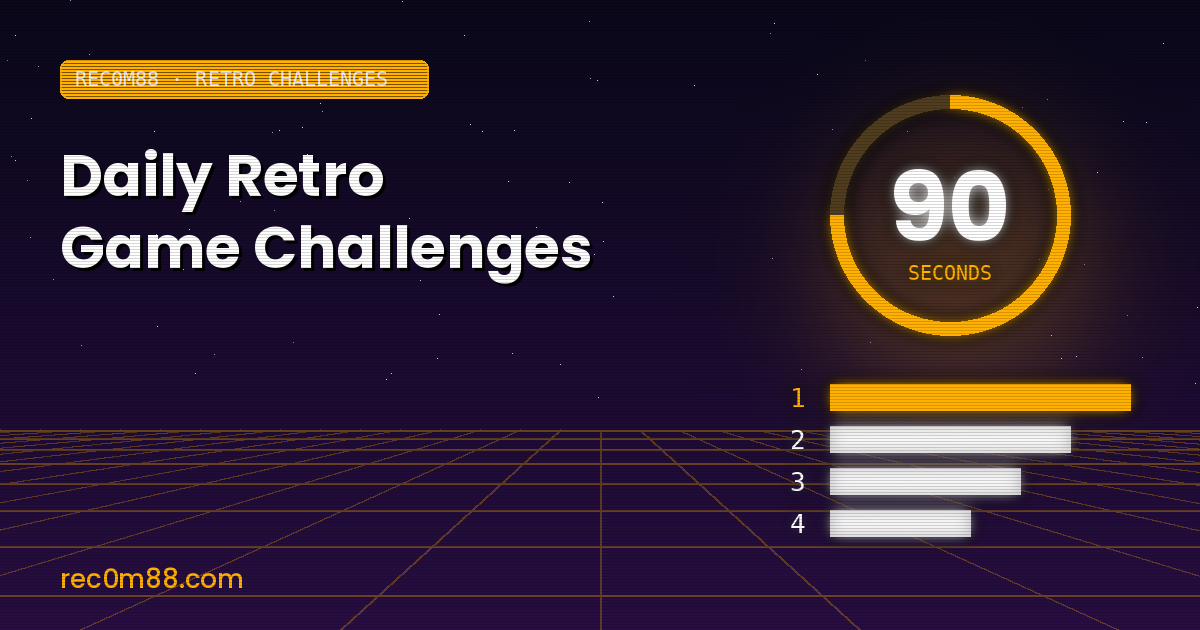
El Rec0m88 Retro Challenge Arena is my attempt to bring that feeling back. Every day there’s a new classic game, everyone gets 90 seconds per run, and the leaderboard shows who did best. It runs right in your browser, so there’s nothing to install.
This post explains how the arena works, why I built it the way I did, and a few tips for climbing the boards.
How the arena works
The arena has three kinds of competition running at the same time.
The daily challenge. A new NES, SNES or Sega Genesis game is featured every day. You get 90 seconds per run, you can try as many times as you like, and your best score is the one that counts. When the day ends, a new game takes its place.
The weekly challenges. Two more games stay up for a full seven days. These boards move slower and reward people who keep coming back to refine their runs over the week.
The all-time records. Every game in the challenge library keeps its best score ever, and the top runs live in the Hall of Fame.
The leaderboards update live, so you can watch your name climb (or get pushed down) in real time.
Why 90 seconds?
The run length was the most important decision in the whole design, and it took some trial and error.
Shorter runs felt too random. A lucky start could beat a skilled player, and the game barely had time to get going. Longer runs had the opposite problem. They were great for dedicated players, but most people didn’t have time to sit through several tries, so they’d play once and leave.
Ninety seconds lands in the middle. It’s long enough that skill clearly wins over luck, but short enough that “one more try” is always tempting. You can fit a few runs into a coffee break, and that matters. A challenge people actually play is worth more than a perfect one they skip.
Why a fixed time limit changes how you play
Most classic games were designed around lives, not time. You play until you run out of chances, and a great run might last half an hour. A time limit flips that around.
With only 90 seconds, survival stops being the main goal. Points per second becomes everything. Players who are used to playing carefully suddenly have to take risks, chase bonuses, and skip anything that wastes time. It turns games you’ve known for decades into something that feels new again.
It also levels the playing field. Someone who has never played a particular game can learn its scoring in a few runs and compete with people who grew up with it. That’s a big part of why the daily rotation works. Everyone is learning together.
Tips for climbing the leaderboard
The best players in the arena tend to follow the same habits.
Learn what scores points first. Spend your first run or two just figuring out what’s worth the most. In many classic games, a few actions are worth far more than everything else, and finding them early is the biggest jump you’ll make.
Don’t play it safe. With a fixed timer, losing a life often costs you less than playing slowly. If a risky move earns big points, it’s usually worth trying.
Plan a route. The game stays the same all day, so use your early runs to plan exactly where you’ll go and what you’ll do in the opening seconds. Top scores almost always come from a practiced opening.
Watch the clock near the end. Points that land after the timer hits zero don’t count. In the last few seconds, go for quick points rather than a big combo you won’t finish.
Come back to the weekly boards. Daily challenges reward fast learners. Weekly challenges reward patience. If you like grinding out a perfect run, the weekly boards are where you’ll shine.
Built for every device
The arena runs in any modern browser, on a desktop, laptop, Chromebook or phone. It uses the same WebAssembly-powered emulation as the rest of the Rec0m88 arcade, which I wrote about in The WebAssembly Revolution. On phones you get touch controls, and you can connect a Bluetooth controller if you want a more console-like feel.
There’s nothing to download, no plugins, and no setup. You click the challenge and you’re playing.
Keeping it fair
A leaderboard is only fun if people trust it. Every challenge is set up so all players start from the same place with the same rules, and scores are checked before they land on the board. I won’t go into the details here, for obvious reasons, but if something on a leaderboard looks wrong, use the página de contacto and I’ll take a look.
Why I built it
Rec0m88 started as an emulator for playing classics with friends over netplay. The challenge arena grew out of the same idea from a different direction. Netplay brings people together to play cooperatively or head to head in real time. The arena brings people together around the same game on the same day, even when they never play at the same moment.
Both come back to the same goal: keeping classic games played, not just preserved in a folder somewhere. If you’d rather play with a friend than against the clock, the Rec0m88 desktop emulator has full netplay for 18 classic consoles.
Today’s game is waiting in the Retro Challenge Arena.
Preguntas frecuentes
How long is each challenge run? Each run lasts 90 seconds. You can play as many runs as you want, and your best score counts.
How often does the challenge change? There’s a new daily challenge every day, plus two weekly challenges that each last seven days.
Which consoles are in the challenges? The challenges use NES, SNES and Sega Genesis games.
Do I need to download anything? No. The challenges run in your web browser on desktop and mobile.
Is it free? Yes. The Retro Challenge Arena is completely free to play.